 Japan eSIM | DJB
 South Korea eSIM | DJB
 Thailand eSIM | DJB
 Americas eSIM | DJB
 Americas eSIM | DJB
 Philippines eSIM | DJB



Compared to an eSIM, most people are probably far more familiar with a SIM card — as long as you've used a phone for calls, you've needed a carrier's SIM card, that little chip card inserted into a phone or wearable device that's the soul letting your phone communicate and connect to a mobile network. So what exactly is an eSIM? Actually, many newer phones already have this feature, but plenty of people haven't used it, or don't even know it exists. eSIM stands for "Embedded-SIM," known in Chinese as an "embedded SIM card" or "virtual SIM card" — but can a purely virtual card really handle calls and network connections?
[DJB | LINE GO exclusive airport transfer discount $300 ✈️]
From now through 2024/04/14, order any DJB data SIM to get 5% off
plus an exclusive LINE GO airport transfer discount of $300
The discount code is right in this article! Click to unlock it >> https://lihi2.com/eb4PI
Let LINE GO take you around the world with efficient transfers 🚙
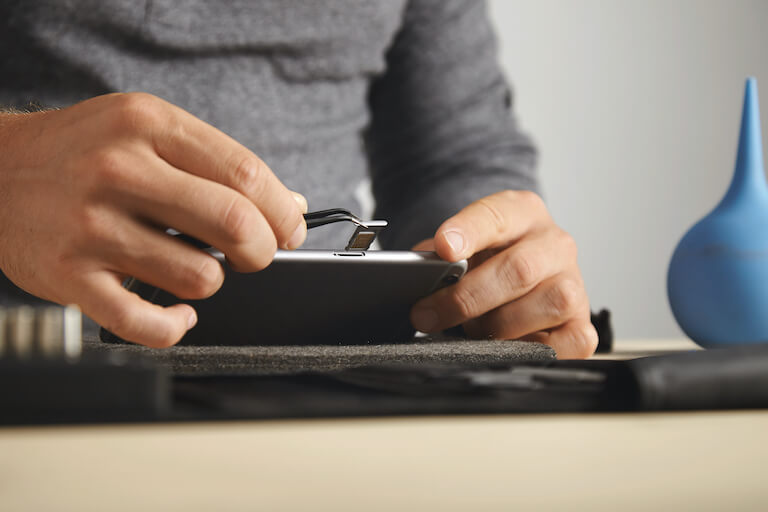
SIM
What is a SIM?
"SIM card" is the general name most people use, mainly because a SIM typically appears to everyone as a physical card. SIM stands for "Subscriber Identity Module."
But don't underestimate this small chip — it actually contains a tiny CPU processor inside, handling basic program operations, storage, and communication functions. Think of it as a miniature computer. On one side of the SIM card sits a metal chip, actually divided into different zones that each connect to different parts of the phone. Each zone has its own contact points and functions — covering original system data, power supply, voltage, and usage data. So this tiny SIM card actually holds plenty of hidden secrets~
The evolution of the SIM card
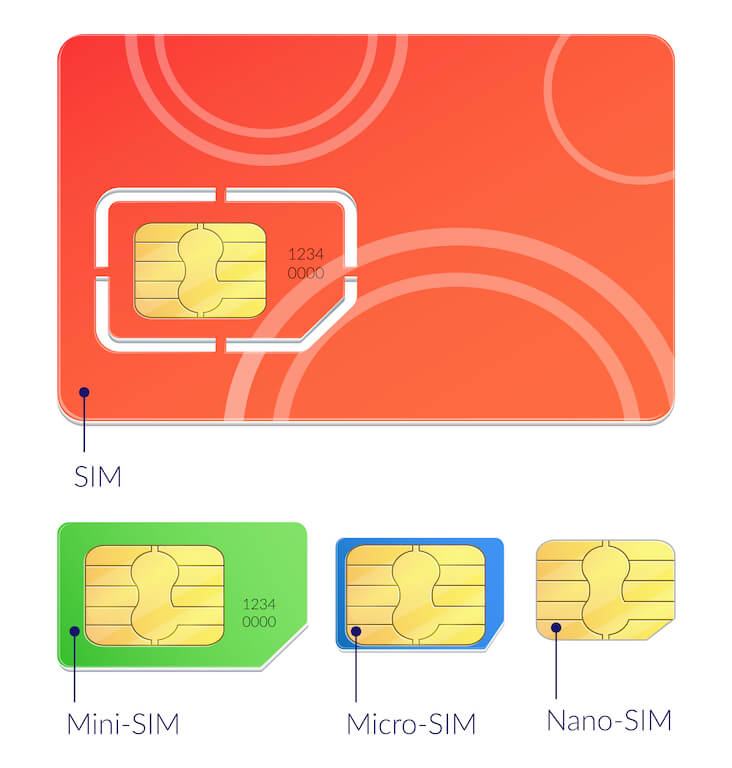
Have you noticed traditional SIM cards keep getting smaller? From the original "Mini SIM," to "Micro SIM," and now "Nano SIM," shrinking from 2.5cm down to just 1.23cm (see Figure 1).
*As early as the 1990s, the very first SIM cards (the "full-size" original) were as large as a credit card (like the entire red card shown in Figure 1), but most people have only encountered the following three formats!
Battery life is one of the most important factors for most smartphone users, and to free up internal space for hardware components and larger batteries, phone manufacturers have pushed SIM cards to keep shrinking — helping boost profit margins and competitiveness in the process.
As technology advances, an era with no SIM card at all is quickly approaching — Apple has even been reported to remove the physical SIM tray in recent iPhone generations, shifting to a dual-eSIM design instead.
eSIM (Embedded-SIM)
Overview
Standing for "Embedded-SIM," known in Chinese as an "embedded SIM card" or "virtual SIM card," it's a standard jointly introduced by device manufacturers, published by the GSMA (GSM Association) in 2016.
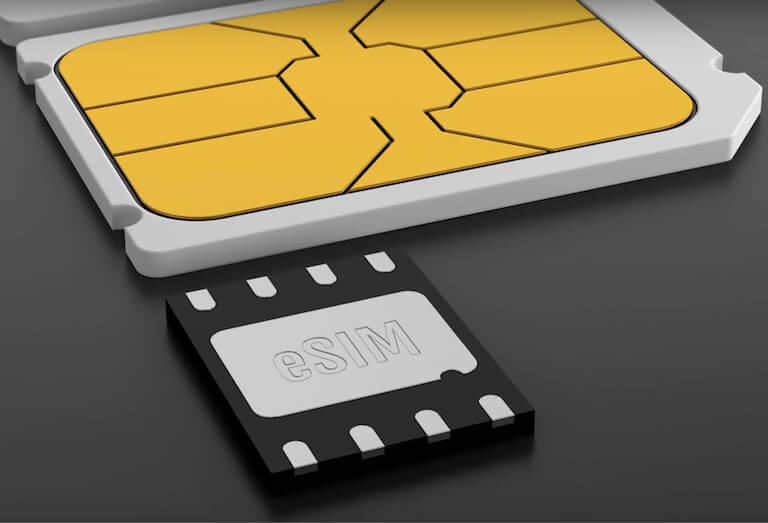
Since there's no visible physical card or tray, it looks virtual — but there's actually still a physical chip (a SON-8 packaged IC) embedded directly onto the mobile device's circuit board, much smaller than a traditional SIM card. This is a huge advantage for device manufacturers, saving significant internal space.
How it came about
While SIM cards kept shrinking, it still wasn't enough for device manufacturers — beyond the SIM card itself, the tray space and wiring all take up room, and on wearable devices in particular, this genuinely eats up too much space. Here are the three main needs that drove its development:
- Traditional SIM cards take up too much space (especially in wearables: smartwatches, fitness trackers, smart glasses)
- SIM cards connect via metal contacts, carrying a risk of poor connections
- Switching numbers is inconvenient, requiring a trip to the carrier for a new physical SIM
To free up space on devices for other applications, developers worked hard on a solution, and Apple and Samsung finally partnered to launch eSIM together in 2015. Once the GSMA published its standard in 2016, it quickly won support from smartphone manufacturers across the industry.
How is it different from a traditional SIM card?
| eSIM | Traditional SIM | |
|---|---|---|
| Using it on your phone | Directly scan to add a mobile plan |
Manually swap the physical card (requires visiting a carrier store) |
| IoT applications | Fast, convenient | Harder to scale quickly |
| Travelling abroad | Purchase and activate instantly |
Buy a card ahead of time Swap it at a carrier store |
Functionally, there's really no difference between the two — data transfer, network quality, and speed all stay the same regardless of which one you use. In fact, an eSIM still contains a physical chip embedded on the phone's circuit board — it's simply invisible and doesn't need manual swapping. At carrier stores in Taiwan, even if you're currently using a traditional SIM, as long as your phone supports it, you can switch directly to eSIM at the store (your number stays the same).
What is Dual SIM Dual Standby?
"Dual SIM Dual Standby" has become a buzzword since it appeared as a recent iPhone feature — as the name suggests, it means using two SIMs simultaneously, both actively serving you. This differs a bit from the dual-SIM phones some Android devices have offered in the past — this section explains it specifically in the context of eSIM-capable phones~
Starting with the iPhone XS/XR, dual SIM dual standby was first supported, letting the iPhone store two SIMs and make/receive calls and texts without manually switching. Starting with the iPhone 13, dual eSIM is supported too, covering two combinations: "physical SIM + eSIM" or "two eSIMs."
This feature further splits into "single active" and "dual active" modes. In single active mode, only one number can receive a call at a time — if number A is on a call, an incoming call to number B goes straight to voicemail. The iPhone follows this model.
Pros and cons
eSIM's emergence is essentially an inevitable trend in device and IoT development. While it's still in a growth phase, with some rough edges in functionality and use cases, here are the pros and cons!
Pros
- Convenient — no more hassle of manually swapping SIM cards
- No tray or chip interface needed, significantly saving device space
- No card swap or roaming needed for travel or business trips — just directly join a local data plan (great immediacy)
- Instantly becomes a dual-SIM device, with one physical SIM plus at least one eSIM
- Even if your phone is lost, its signal can still be traced
- No worrying about losing a card while traveling, since there's no card to swap
- Broad range of applications — beyond phones, wearables and IoT products all benefit too
Cons
- Your device must support it to use it
Smart devices
Supported phones
Apple Google Apple- iPhone 13, iPhone 13 mini, iPhone 13 Pro, iPhone 13 Pro Max
- iPhone 12, iPhone 12 mini, iPhone 12 Pro, iPhone 12 Pro Max
- iPhone 11, iPhone 11 Pro, iPhone 11 Pro Max
- iPhone XR, iPhone XS, iPhone XS Max, iPhone SE
- Pixel 6, Pixel 6 Pro
- Pixel 5
- Pixel 4, Pixel 4a
- Pixel 3, Pixel 3 XL
- Find X3 Pro
Supported wearable devices
Smartwatches Tablets IoT devices Smartwatches- Apple Watch S7, Apple Watch S6, Apple Watch SE, Apple Watch S3, Apple Watch S4
- Galaxy Watch series
- 11" iPad Pro, 12.9" iPad Pro (3rd generation), iPad Air (3rd generation), iPad mini (5th generation)
- Updating soon..
How to use it
How to add a mobile plan
- Apply for a plan with the carrier
- Scan the QR code provided by the carrier using your phone
- Select "Add mobile plan" and follow the steps to complete setup
Activation and usage steps
- Turn on the added mobile plan
- Enable mobile data (and enable data roaming if abroad, depending on your plan)
Market and future outlook
Embedded SIM cards have an incredibly wide range of applications — beyond smartphones, they're used in electric vehicles, consumer electronics, energy, public infrastructure, wearables, and IoT devices. The global market was estimated at $5.4 billion in 2022, projected to reach $16.6 billion by 2026, with a compound annual growth rate (CAGR) exceeding 15% — demand for eSIM devices across every sector is bound to grow explosively in the years ahead.
Further reading:
>> The complete guide to internet in Japan: a comparison chart for travellers to help pick the right option for a smoother trip
>> Data SIM, pocket Wi-Fi, or international roaming for Korea? Comparing the pros and cons of all 3 options
>> A guide to choosing a Europe data SIM: comparing SIM cards, pocket Wi-Fi, and roaming — this one's fast and affordable
Comments are closed for this article.
Comments (0)