 Japan eSIM | DJB
 South Korea eSIM | DJB
 Thailand eSIM | DJB
 Americas eSIM | DJB
 Americas eSIM | DJB
 Philippines eSIM | DJB


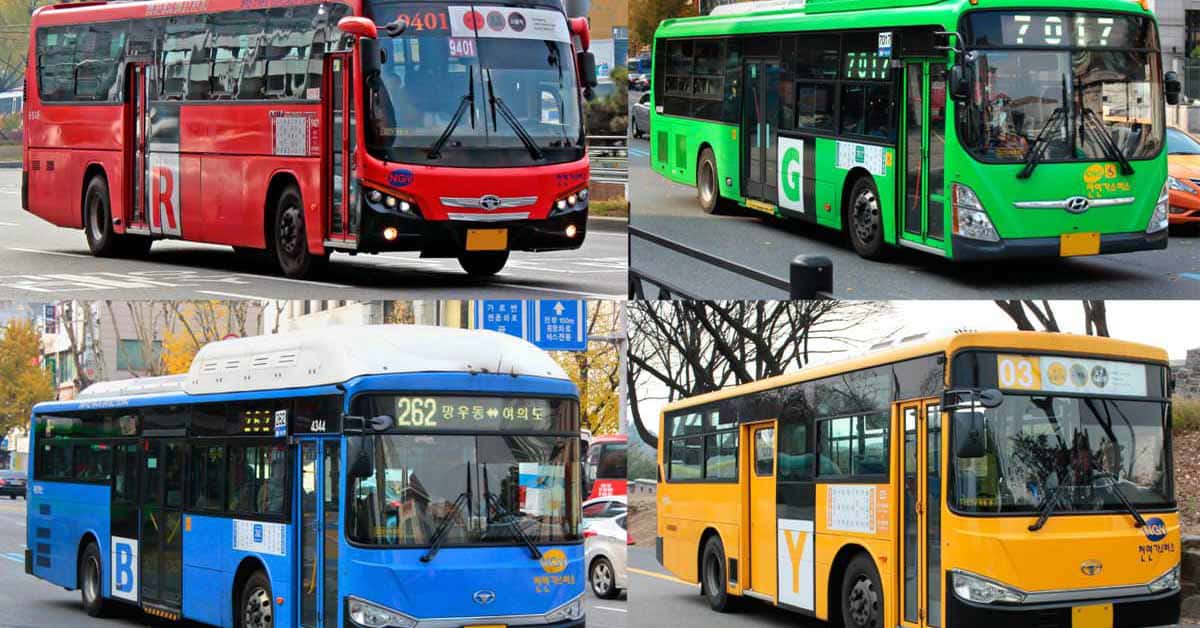
Did you know Korean buses are actually a really convenient way to get around? In fact, buses can sometimes get you there faster than the subway! Bus numbers in Korea usually have three digits: the first digit shows the area where the route starts, and the second digit shows the area where it ends. But how do you ride a bus in Korea if you do not speak Korean? It is really not that hard — let's take a look!
An introduction to Korean buses
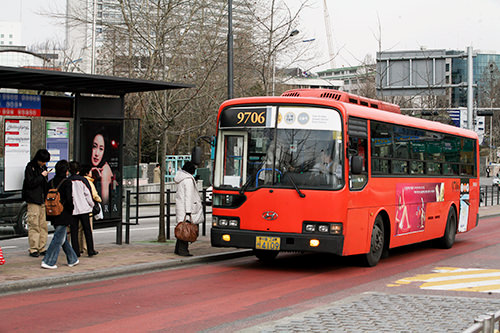
Red buses
Red buses in Korea are mainly long-distance services running between Gyeonggi Province and Incheon (covering Seoul, Gyeonggi, Gangwon and Incheon). Routes starting with 9 run to and from Gyeonggi Province, while routes starting with 8 are express trunk routes.
One thing to note: if you are just riding a bus to nearby attractions within Seoul, avoid the red buses — they cost noticeably more!
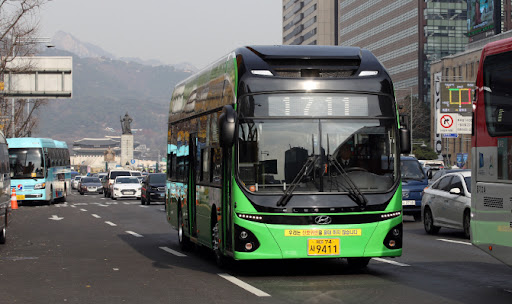
Green buses
Green buses are Korea's second most common form of transport, and come in two types: one resembles Taiwan's small local buses (with a route code combining a letter for the area plus two digits), circulating within areas the subway does not reach well; the other is a larger bus (with a four-digit code) that runs along secondary roads, connecting subway stations or serving areas the subway does not extend to. Green buses run frequently and cover short distances, often weaving into narrow side streets, making them genuinely handy for anyone whose home is a little too far from the nearest subway station.
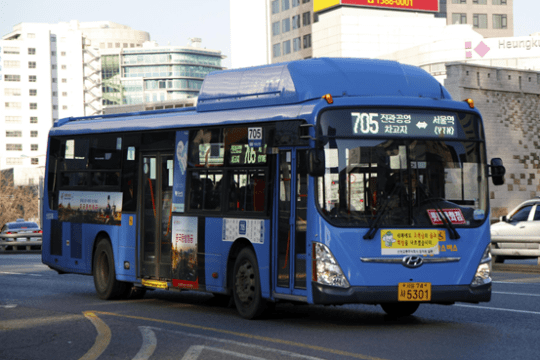
Blue buses
Blue buses are the most common in Korea! With the most frequent services, they are the top choice for both locals and tourists. Blue buses mainly run along major roads and connect subway stations, saving commuters transfer time along the way — making them the most convenient bus option.
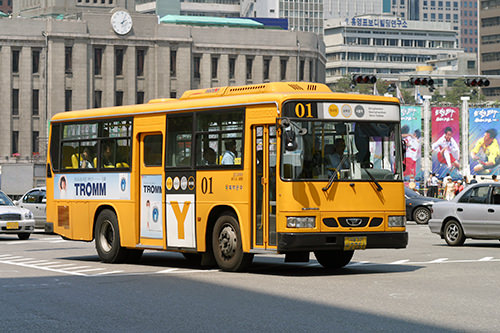
Yellow buses
Yellow buses circulate through specific tourist areas of Seoul, reaching attractions such as Myeongdong, Namsan Tower and Gyeongbokgung Palace. Since these are tourist shuttle services, it is worth checking the schedule in advance. This is exactly when a good Korean data connection matters! Bring DJB's no-throttle Korea data SIM, and you can stay online wherever you go — city or countryside — so a wrong turn or a stuck map never ruins your day 🥰
Korean bus fares
Bus type (adult / teen / child fare)
Red bus: adult ₩2,300 / teen ₩1,360 / child ₩1,200
Green bus: adult ₩1,200 / teen ₩720 / child ₩350
Blue bus: adult ₩1,200 / teen ₩720 / child ₩450
Fares in Korea are almost always paid by tapping a card, and the fares above reflect the card price. We recommend using a card whenever possible — beyond the transfer discounts between bus and subway, it is simply more convenient. If you are travelling with teenagers or children, you can register their discounted fare at any subway service centre or convenience store by showing a passport.
Transfer discounts
- Subway to bus, or bus to subway, within 30 minutes
- Between 07:00 and 20:59
- Subway to bus, or bus to subway, within 60 minutes
- Between 21:00 and 06:59
Things to know about Korean buses
- Buses in Korea generally follow "board at the front, exit at the back", and you must tap your card both boarding and alighting
- Eating and drinking is not allowed on Korean buses
- Most Korean buses offer free Wi-Fi
- For the stop announcement, the first name called out is the stop the bus is about to arrive at; the second name called is the following stop
- Night bus fares have been raised to ₩2,150
That rounds up our guide to riding buses in Korea — hopefully it helps make getting around by bus in Korea a little smoother for your trip.
Further reading:
>> Before you explore Seoul's sights, get up to speed on data, transport, payments and must-have apps
>> 10 best cherry blossom spots in Korea — do not miss these dates for Seoul and Busan sakura
>> Comparing Korea's 3 main data options: how to choose a SIM for a fast, smooth trip
Comments (0)