 Japan eSIM | DJB
 South Korea eSIM | DJB
 Thailand eSIM | DJB
 Americas eSIM | DJB
 Americas eSIM | DJB
 Philippines eSIM | DJB



Which US carrier has the best network? We get asked this a lot — how do you choose a data SIM for a US trip? Because the US spans such a huge area, band support among carriers differs a lot compared to other countries, and different phone brands may face varying limitations. Here are the key points to help you choose the right plan with ease!

The US is the world's fourth-largest country by area, and while its telecom infrastructure is well developed, some remote areas may still have weak or no signal — though overall performance still beats most countries worldwide. There are three major carriers in the US: Verizon, AT&T, and T-Mobile (US). All three launched 5G networks back in 2019, though it is still limited to small parts of certain cities and not yet fully built out, so this article focuses mainly on 4G/3G when comparing each carrier.
An overview of the US's 3 major carriers
AT&T
AT&T and Verizon are widely considered the two biggest carriers in the US, offering landline phone service, mobile service, and broadband. In terms of data coverage, it is fairly close to Verizon, with signal reaching most small towns and remote areas too. Pricing sits in the middle range, making it a common first choice for travellers and business visitors to the US.

Verizon
Verizon and AT&T are widely considered the top two carriers in the US, with a huge domestic user base and broad service coverage, offering the widest signal reach among the three major carriers. That said, travellers from outside the US generally do not opt for Verizon, for two main reasons: Verizon relies on somewhat unusual bands with fewer supported phone models, and activation requires providing your phone's IMEI. It is also the priciest of the three carriers.
T-Mobile US
T-Mobile is a global telecom company, operating in the US specifically as "T-Mobile US". After completing its merger with Sprint in 2020, it jumped almost overnight to a scale comparable with AT&T and Verizon, ushering in an era of three evenly matched major carriers in the US. T-Mobile US holds its own against the other two in big cities in terms of signal and speed, and lags only slightly in more remote areas. Overall, in my own experience using it, the network held up genuinely well, and combined with T-Mobile's very affordable plans, it is a popular choice for many travellers.
Bands used by US carriers
The bands the US uses for 3G/4G differ significantly from other countries, and given the country's sheer size, supporting one or two bands does not guarantee coverage everywhere in the US — the more bands your phone supports, the better. Check which bands your device supports before choosing!
| Carrier | AT&T | Verizon | T-Mobile US |
|---|---|---|---|
| Coverage | Full | Full |
Full (slightly weaker in remote areas) |
| Signal quality | Best | Best | Second best |
| Price | Mid-range | Most expensive | Cheapest |
| How to activate |
Activates on a set date (US Pacific time) |
Supports iPhone/Pixel only Activation requires phone IMEI |
Activates on a set date (US Pacific time) |
| Bands |
Band 2 (primary coverage) Band 4 (primary coverage) Band 5 Band 17 (primary coverage) Band 30 Band 66 |
Band 2 (primary coverage) Band 4 (primary coverage) Band 5 Band 13 Band 66 |
Band 2 (primary coverage) Band 4 (primary coverage) Band 5 Band 12 Band 66 Band 71 |
Overall, all three US carriers perform well on both coverage and network quality. The main difference lies in the specific 3G/4G/LTE bands and frequencies each carrier relies on, which also vary by city and region — so it is entirely normal to notice quite different network performance depending on where you are in the US. This naturally also depends on the bands your own phone supports!

Among more recent phone models, the following largely support US carriers' 4G/3G bands in full:
- iPhone series (iPhone 6s and newer)
- Samsung series (Note / S)
- Sony series (X / XZ)
- Huawei (Mate 10/9, P 10/9)
Whether or not your phone appears on this list, we still recommend double-checking your device's supported bands beforehand for a smoother trip!
Coverage maps for US carriers
AT&T
T-Mobile US
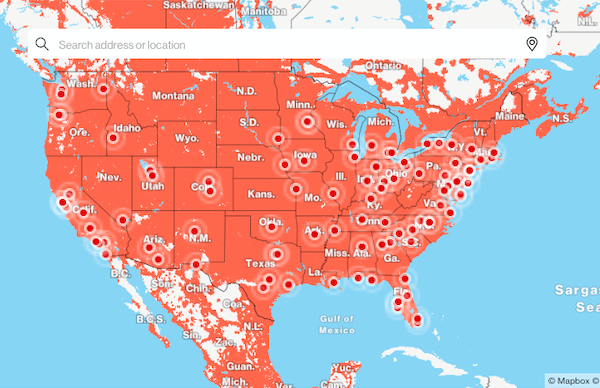
Verizon
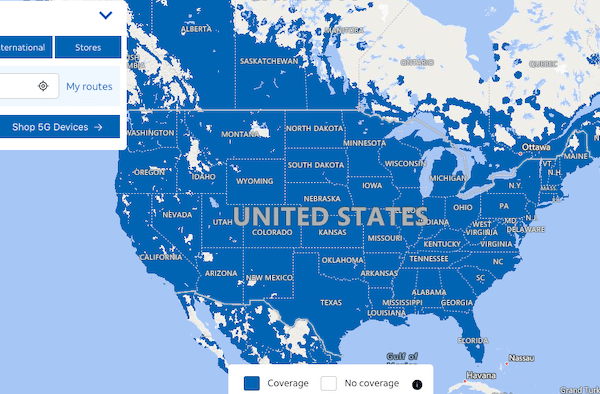
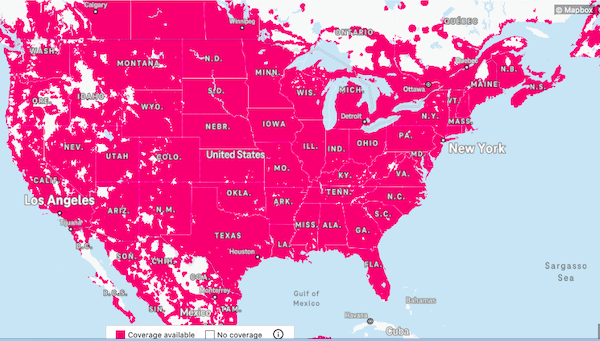
Above are coverage maps for each of the US's carriers — check the region you are visiting directly! Anyone travelling, working, or studying in the US typically ends up choosing one of these three: Verizon, AT&T, or T-Mobile US.
Aside from Verizon's limited phone compatibility and cumbersome activation process, AT&T and T-Mobile US have very similar coverage and user bases in practice, and are the go-to choice for most travellers from other countries — also widely available through online channels in many countries. DJB's US unlimited data SIM also runs on T-Mobile US, covering the US, Canada and Mexico with a single SIM~ Based on my own experience using both carriers in the US, the difference in day-to-day usage is genuinely minor — both perform above a solid standard.
Further reading:
>> The best time to travel abroad in 2024 — pick the right season for pleasant weather and lower costs
>> 2024 guide to travel inconvenience and travel accident insurance, for anyone worried about flight delays
>> How to apply for off-site airport MRT check-in? 3 super-easy methods, all doable from your phone
Comments are closed for this article.
Comments (0)